

“Honey is hard work and only made in excess. The hive will prioritize itself and its health over making honey for you.”
The first time that you end up tackling honey extraction and it can really seem overwhelming when you first start dipping your toes in. Depending what stage of your bee journey, you should set some realistic expectations for “Honey Yield”.
The first year or so that you have your hive, depending on how you started it, it may not have enough honey produced to harvest. Once the hive has really reached maturity, that is when you will find your hive brimming with honey waiting for frames to be pulled or a brand new set of frames to be added so they can continue storing more. This is a good sign! It means that the colony is healthy and has plenty of resources to produce more honey than is needed. As I dive more into our summer care and schedules, I will explain the harvesting windows more in depth then. For now early spring is when we did our first harvest.
The frames that you end pulling will either be one of two sizes, Deep or Medium. Shallows are not typical to harvest. For the purpose of this blog, I am just going to be talking about pulling frames from our two Langstroth Hives. There are various different hives that can incorporate different frame structures. (Top bar, flow hives etc.) Below I will break down the basics steps of honey extraction and some tips / tricks I learned along the way
- Deciding if a frame is ready for harvest
- Capped vs Uncapped
- Brood present?
- Frame Preparation
- Wrapping the frame
- Freezing the frame
- Plan to harvest
- Uncapping / Spinning
- Frame warming to above room temperature
- Uncap in a diagonal pattern
- Spinning techniques
- Filtering
- FIltering Equipment
- Secondary and Primary Storage

Deciding if a frame is ready for harvest?
When trying to decide if it is time to pull a frame for harvest, I feel that there were a ton of things to consider and I wasn’t totally sure if I would be doing things correctly. These are the main things that I was considering when pulling the frame
- How much of the frame was harvestable
- The target that I was shooting for was typically between 75 and 80% of the frame being covered in capped honey
- Was there any brood in the surrounding frames
- When pulling frames, I wanted to ensure that there was food for any of the emerging bees.
- This caused me to focus my attention on the frames that were near the outside of the boxes
- Most of the time, the queen will start laying at the center of the box so that things can work there way out to the edge of the box
Frame Preperationn
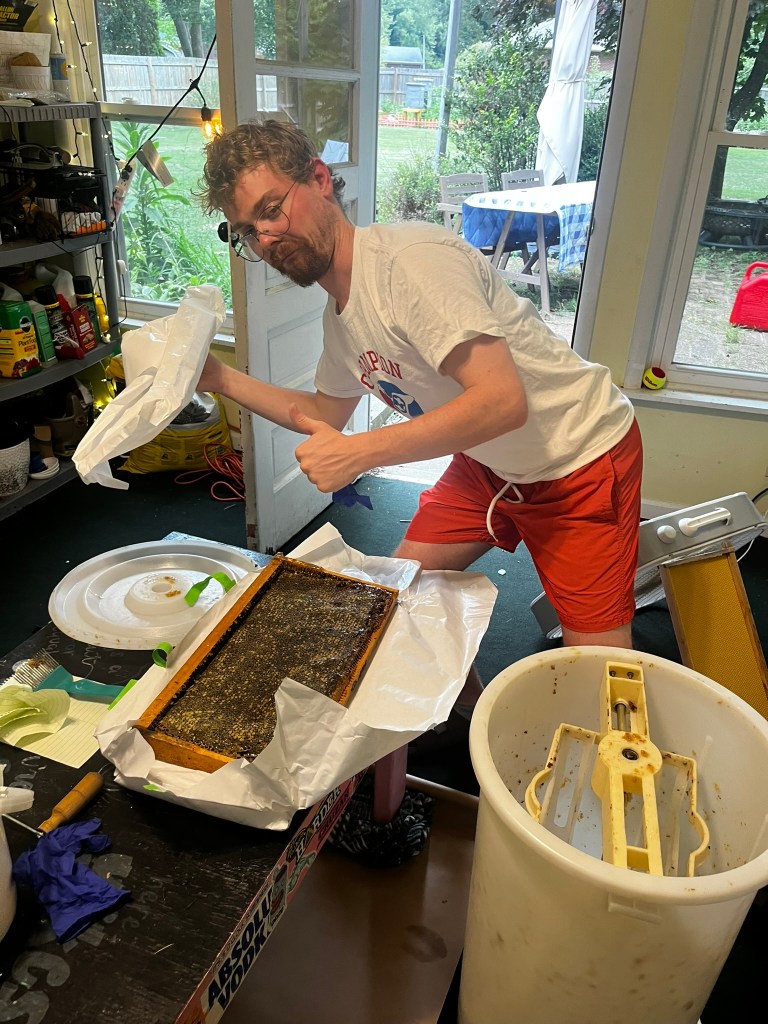
Prior to extracting the honey, the frames need to be prepared so that there is not a chance of parasites in the honey being extracted. When I pull a frame. The first thing that I do is completely wrap it in freezer paper to prevent spillage. I then will label the farme with the date that I wrapped it. I target about 2 days for freezing just to feel confident that there isnt anything left that could be an issue.
Uncapping and Spinning
When uncapping, I found it to be easier when the frame was above room temperature. This allowed the honey to flow out of the farme easier. Scraping in a diagonal pattern made sure that there was no cap uncapped.
Filtering
The last step of the process is how you plan on filtering. For us, I used a few different levels of thickness cheese cloths. This allowed me to pull out a ton of the cappings and other debris.
Finally we bottled! Feel free to leave comments with questions! See ya next time

 CD&Sprouts
Leave a comment